
Maritime Museum Wedding Photographer: The Complete Dún Laoghaire Guide
Maritime Museum Don Laoghaire
There is a lighthouse where the altar used to be.
The Baily Optic came off Howth Head in 1972. It weighs the guts of ten tonnes and it still turns on a bath of mercury. It stands at the top of the old Mariners' Church in Dún Laoghaire, so couples who get married at the National Maritime Museum of Ireland say their vows in front of it. James Joyce put that exact light into Ulysses. Now people get married under it on a Friday afternoon.
I work as a Maritime Museum wedding photographer and I live five minutes from the door of it. I have photographed a wedding in that room, walked the party down to the park afterwards and stood in the courtyard while a horse box bar poured prosecco. This guide is everything I would tell a couple who rang me about it, including the parts the venue's own page does not cover.
If you are weighing the building up, or you have booked it and want to know how the day runs, start here.
About the venue
The building is the Mariners' Church. Joseph Welland designed it. It was built by subscription from 1836, consecrated in June 1843 and put there for the sailors of Kingstown Harbour. Around a third of the seats were reserved for seafaring families. The enclosed Royal Navy prisoners' docks are still in the room. Prince Albert visited in 1849 and called it a hideous building like a gigantic barn, which tells you more about Prince Albert than about the church.
The last service was on Easter Sunday 1972. President Patrick Hillery opened the museum in 1978. It then closed for six years for a refurbishment costing just under four million euro. President Michael D. Higgins reopened it in June 2012 as one of the few large mariner churches left in the world.
The original altar left the building in 1975. The Optic arrived in its place. It was too heavy for the middle of the floor so they built a retaining wall in the basement to hold it up.
What you get as a couple is a forty foot chancel arch, lancet windows, restored Victorian stained glass, memorial plaques the length of the walls and a gallery running above the nave. Ship models, a hard hat diving suit and the Irish Lights exhibit share the room with you. That is either the whole appeal or a dealbreaker. Work out which one you are before you book.
On numbers, the museum states seated guests from four upwards and publishes no maximum. I have photographed fifty guests in there with room to spare. If you are planning bigger, ring them rather than guessing, because nobody publishes the ceiling.
The best spots for wedding photos
Inside. The Optic is the shot and the venue knows it. Everything at the top of the room reads well because the chancel arch gives you height and the glass gives you colour. The aisle down the nave is long enough to work with. If you want a frame looking down on the ceremony from the gallery, ask in advance, because the gallery is not part of the standard hire.
The courtyard. The outside space beside the museum takes a drinks reception. I have watched guests dance on it at four in the afternoon while a singer took requests.
Five minutes on foot. Moran Park and the dlr LexIcon are next door, which gives you modern granite and glass as a counterweight to all that Victorian stone. The Victoria Fountain sits at the bottom of Marine Road. The East Pier entrance is about four minutes down through the park.
Ten minutes on foot.People's Park has a bandstand, two fountains and a Victorian shelter. The East Pier bandstand is restored ironwork from 1890, out on the upper deck. The Dún Laoghaire Baths at Newtownsmith reopened in 2022 with a thirty five metre jetty running out over the water. It faces northeast across Scotsman's Bay to Howth.
Worth a car. Sandycove, the Forty Foot and the James Joyce Tower are two kilometres east, five minutes driving. The West Pier is an earthen track rather than a promenade, which makes it hopeless in heels and the only place around the harbour that still looks nineteenth century.
The light. Most people get this backwards. Dún Laoghaire faces north and northeast. The sun does not set out to sea in front of you. It sets behind the town over the West Pier and Monkstown, so your warm surfaces in the evening are Howth Head, the East Pier and the water inside the harbour mouth. Stand on the East Pier and look back at the town for your sunset.
The season matters more than the spot. In late June the sun goes down around ten to ten, roughly six hours after your ceremony has finished, which makes an evening walk on the pier a separate excursion rather than a continuation of the day. By the first week of September sunset is around quarter past eight. By the third week it is closer to half seven. September at this venue gives you a golden hour you can actually use.
What to expect on your wedding day
The most important fact about this venue is the clock. Ceremonies run between 12.30pm and 3.30pm only. You get access an hour and a half before. The room is yours for two hours from the start of the ceremony, not from the end of it. A two thirty ceremony means you are set up from one and out by half four.
Hire is €1,250 with a €250 deposit to hold the date, as listed on the museum's wedding page. That covers guest seating, ornate chairs for the two of you, a red carpet, eight lanterns with LED candles, microphones for your celebrant and readers, a Bluetooth connection to the house PA and a table for the register signing. Decorating the day before can be arranged and may cost extra.
Confetti is strictly prohibited. Save it for People's Park where nobody minds.
Live music works. The wedding I shot there had a singer through the ceremony and the same singer outside afterwards, so you are not stuck with a playlist through the PA.
Then there is the gap. A ceremony that ends at three and a meal that starts at seven leaves you four hours in the middle. That prospect frightens couples more than anything else about this venue. It should not. The afternoon is where the best photographs of the day live, because nobody is being organised and everybody is talking to each other. It just needs planning, which is what my wedding day timeline guide is for.
Practical things nobody tells you. There is no dedicated parking. The LexIcon car park sits beside the museum but holds only about a hundred cars. On street parking around there is capped at three hours, which does not survive a wedding. Point guests at the Pavilion or the harbour car parks instead. The DART station is a two minute walk, which for a Dublin guest list is worth more than any car park. The ground floor is wheelchair accessible. The gallery is not.
One more thing. The museum stays open to the public while you get married. Visitors are paying in at the door. It has never caused a problem on a day I have worked. You should still know it rather than find out.
Where to go afterwards
The museum is a ceremony venue, so the second half of your day happens somewhere else. Everything below is a walk or a short drive.
People's Park Café is seven minutes on foot, sits in the restored Victorian shelter in the middle of the park and does exclusive private hire. A Victorian church for the ceremony and a Victorian park shelter for the dinner is a neat piece of symmetry. The walk between them through the town is a lovely part of the day. They publish no capacity, so ask.
The Royal Marine Hotel is three minutes away, holds several hundred and has four acres of gardens onto the seafront. It is the obvious answer if your numbers are big.
The Royal St George Yacht Club markets itself as a wedding venue and looks straight out over the harbour. The Royal Irish Yacht Club also does weddings, though every event must be booked through an existing member. Further out, the Purty Kitchen's Loft in Monkstown takes a hundred seated.
Real weddings at the Maritime Museum
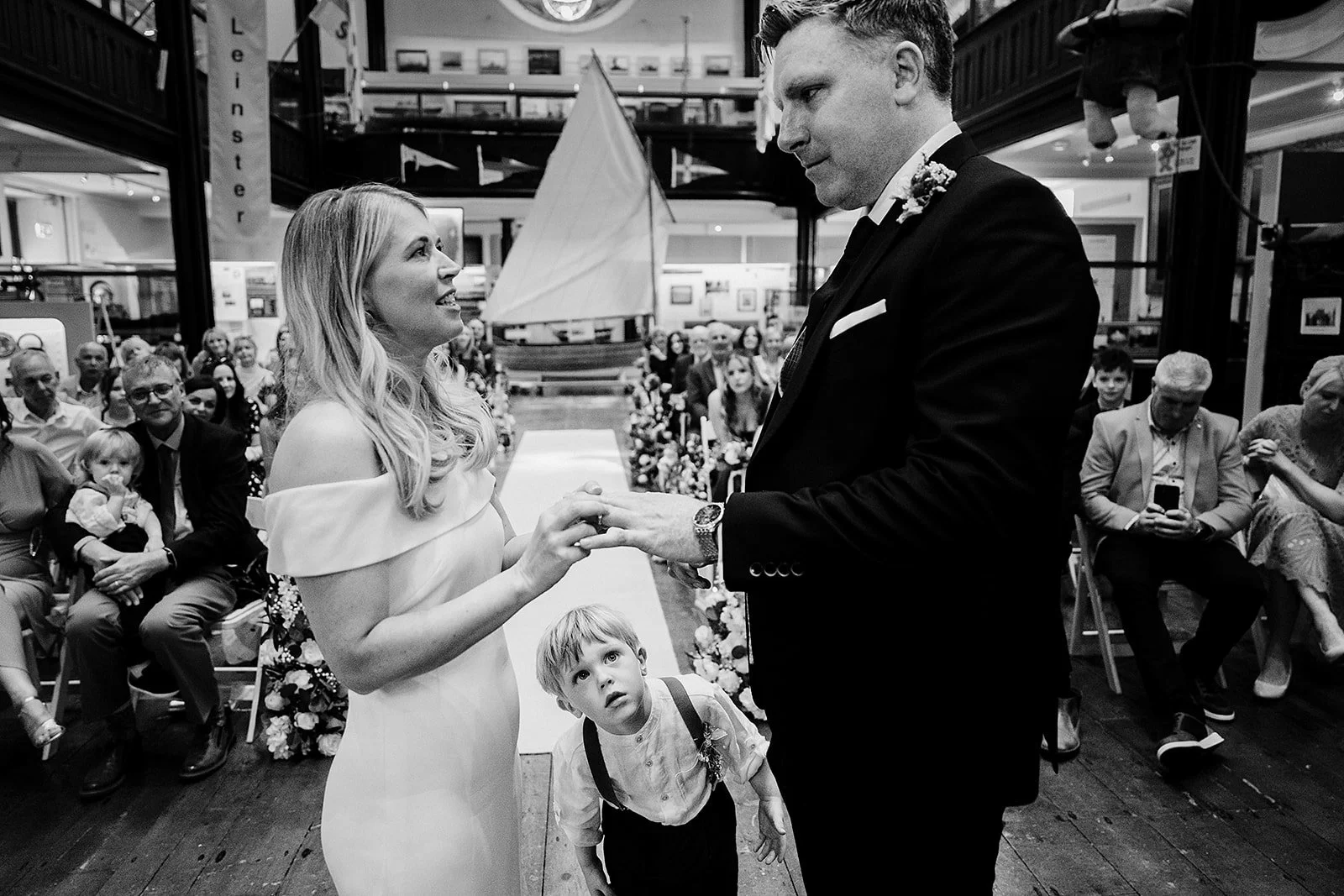
Rowena and Bryan married there on a Friday at the end of July with fifty guests. Their two year old walked into the middle of the vows and stood between them for the first kiss. Afterwards there was prosecco in the courtyard. Everyone then walked down to People's Park Café for dinner. By the time they came back out the park had closed for the evening so they had the whole place to themselves. That post shows you what a full day at this venue actually looks like.
Why a documentary photographer suits this venue
You cannot direct a wedding in a museum. There is no bridal suite to stage things in, no long driveway, no lawn to line people up on and no three hour window to fill with portraits. You have a small room, a tight guest list and everybody within about six metres of each other.
That suits the way I work. I do not pose anyone. I stand back, I wait and I photograph what happens, which in a room this size means faces rather than scenery. When there are fifty people at a wedding instead of two hundred and fifty, every one of them is actually at the wedding. It shows in the pictures. There is more of what I mean in my candid and documentary work.
Working with a Maritime Museum wedding photographer who lives here
I live in Dún Laoghaire. I know which car park fills, which way the light goes in the evening and how long it takes fifty people to walk down to the park, because I have done it. That is a different proposition to arriving at a venue for the first time on the morning of a wedding.
I photograph small weddings often and I like them more every year. There is an intimate wedding package built for exactly this kind of day. If you want to see how a Dún Laoghaire wedding fits into the wider county, there is a photographer's guide to Dublin wedding venues as well.
-
The museum states seated guest numbers from four upwards and does not publish a maximum. I have photographed a wedding of fifty there comfortably. If your numbers are higher, contact the museum directly rather than relying on a figure you read online.
-
Ceremonies take place between 12.30pm and 3.30pm. You have the room for an hour and a half beforehand to set up and for two hours from the start of the ceremony
-
€1,250 at the time of writing, with a €250 deposit to secure the date. That includes seating, microphones, a PA connection, lanterns and a signing table.
-
No. Confetti is strictly prohibited in the building. People's Park is a seven minute walk away and works better for it anyway
-
There is a courtyard beside the museum that takes a drinks reception. Mobile bar suppliers will set up out there. The museum does not advertise catering, so agree the details with them and with your bar supplier well in advance.
Get in touch
If you need a Maritime Museum wedding photographer, or a Dún Laoghaire wedding photographer who lives around the corner and works quietly, tell me about the day. I will tell you honestly whether I am the right fit for it.
I photograph weddings like this all over the country. Here is how I work as a wedding photographer in Ireland.